

The Ecological Benefits of Building With Shipping Containers
A shipping container home can reduce material consumption and construction waste, but the environmental benefit doesn’t arrive automatically with the container. A steel box painted green is still a steel box painted green. Whether it becomes a genuinely lower-impact home depends on which container you buy, how much of it you preserve, how far you transport it and how well the finished building performs.
The strongest environmental case is simple: take a serviceable used structure, extend its useful life and avoid manufacturing some of the materials that a new building would otherwise require.
Reuse Preserves More Than Recycling
Shipping containers contain thousands of pounds of steel. At the end of their freight service, that steel has value and is more likely to be recycled than abandoned in a picturesque field awaiting an architect. Recycling is beneficial, but it still requires collection, processing, melting and fabrication.
Reuse preserves more of the work already invested in the product. The container’s walls, roof, floor frame, corner posts and structural connections arrive as an assembled enclosure. The Environmental and Energy Study Institute identifies using fewer materials and reusing existing ones as practical ways to reduce the embodied emissions associated with buildings.
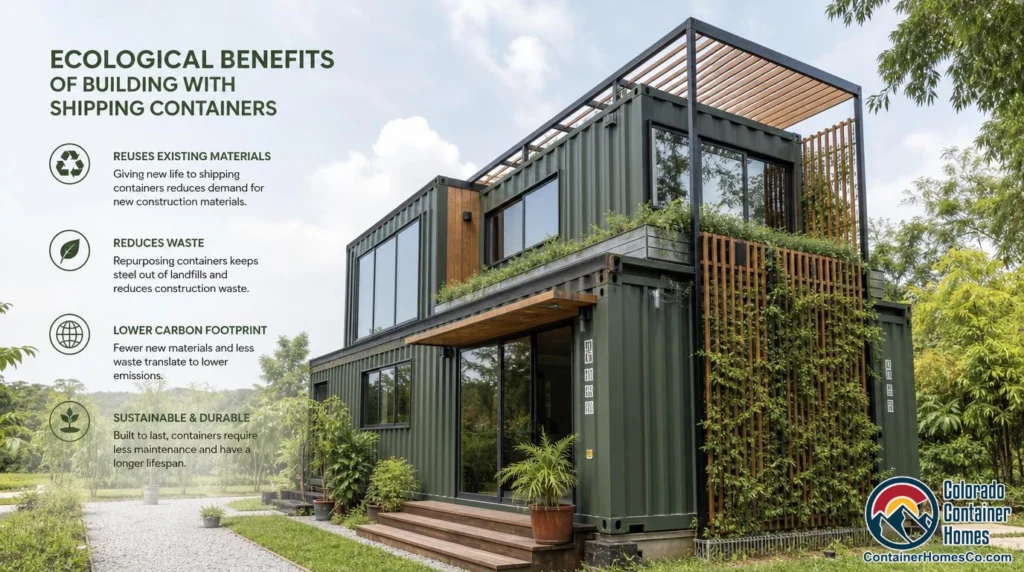
The distinction matters. Claiming that every container home “saves a container from a landfill” is difficult to defend because steel has an established scrap market. The real advantage is that adaptive reuse can postpone recycling while retaining the container’s structural and material value in its current form.
The Best Designs Leave the Container Intact
The environmental payoff is greatest when the design works with the container rather than fighting it. A one-container studio with carefully positioned doors and windows preserves most of the original structure. Joining four containers into an enormous open room may require removing entire walls and installing substantial replacement steel.
At some point, the project starts consuming new material to compensate for the reused material it removed. That doesn’t necessarily make it a bad building, but it weakens the ecological argument.
The International Code Council’s guidance for containers used as buildings helps architects, engineers and code officials evaluate these structures safely. Early engineering can also prevent waste. It is considerably better to size an opening correctly on the drawings than to cut first, discover excessive movement and weld a heroic amount of steel around the mistake.
Factory Conversion Can Reduce Job-Site Waste
Container modules lend themselves to off-site fabrication. A builder can cut openings, weld reinforcement, install insulation and complete interior systems in a workshop where materials are stored properly and offcuts can be sorted and reused. Work is less exposed to rain, mud and accidental damage than it would be on an open building site.
Standardization helps too. When a fabricator repeatedly builds the same 20- or 40-foot model, dimensions and material quantities become predictable. Drywall, flooring, cabinetry and insulation can be ordered and cut with less surplus. The container is also both structure and transportable module, so much of the home can arrive in a nearly finished condition.
This does not make transportation irrelevant. Moving a container hundreds or thousands of miles requires a truck, and placement may require a crane. The environmental case is stronger when the container and fabrication shop are reasonably close to the building site.
Foundations May Use Less Concrete
A lightweight, single-story container home may be supported on engineered piers or discrete footings instead of a full concrete basement or large continuous slab. Where soil, frost, wind and seismic conditions permit that approach, it can reduce excavation and concrete use.
That “where permitted” is doing important work. Foundation design must respond to the actual site. A container placed on an unstable collection of patio blocks isn’t sustainable construction; it is deferred demolition. Poor drainage, corrosion and settlement can shorten the building’s life and erase the material savings that justified the project.
Long service life is an ecological benefit in itself. Durable coatings, proper flashing, repairable finishes and accessible utility systems help the building remain useful instead of becoming an unusually heavy renovation problem.
A Small Footprint Can Reduce Continuing Consumption
Containers impose strict dimensions. A 40-foot unit provides roughly 300 square feet of interior floor area before insulation and finishes consume additional space. That constraint can encourage a smaller home with fewer finishes, fewer furnishings and a smaller volume to heat and cool.
Smallness, however, is the advantage—not some magical property of corrugated steel. A compact wood-framed home may offer similar operational savings. The relevant question is whether the container helps you build less house without sacrificing durability or comfort.
Insulation Determines Whether the Benefit Lasts
Steel conducts heat readily and creates extensive thermal bridging. An inadequately insulated container may require heavy heating or air-conditioning, allowing operating energy to overwhelm savings achieved during construction. Building scientist Joseph Lstiburek describes an uninsulated container as an oven in summer and an icebox in winter.
Continuous exterior insulation can preserve interior width while reducing thermal bridging, although it requires cladding and careful detailing. Interior insulation may be practical, but every inch taken from both walls matters in a room that began only about eight feet wide. Air sealing, controlled ventilation and condensation management must be designed as one system.
Recent research likewise finds that shipping-container envelopes require insulation upgrades to deliver acceptable energy performance. A 2025 study of container-home structural and thermal design emphasizes insulation as a central part of improving efficiency.
A container home is most ecologically persuasive when it uses a genuinely retired container sourced nearby, preserves most of its structure, minimizes new steel and concrete, and receives a climate-appropriate enclosure. Reuse gives the project a head start. Good design decides whether it keeps it.