

Why a Shipping Container Is an Economical Way to Add a Swimming Pool
A shipping container pool occupies a useful middle ground. It is more substantial than the familiar vinyl-sided above-ground pool, but it can avoid much of the excavation, forming and concrete work associated with a conventional in-ground pool. For a homeowner who wants a real lap or plunge pool without surrendering the backyard to a months-long construction project, that difference can translate into serious savings.
Current estimates place a professionally manufactured container pool at roughly $35,000 to $65,000 delivered and installed, although elaborate models can cost considerably more. By comparison, fiberglass pools currently run approximately $55,000 to $100,000, while concrete pools commonly fall between $80,000 and $120,000, according to this 2026 comparison of pool construction types.
Those figures aren’t promises. A container pool on a level, accessible suburban lot may fit comfortably within the lower range. Put the same pool behind a house with no equipment access, bury it in a rocky hillside and surround it with a hardwood deck, and the container won’t perform any financial miracles. It is a pool, not a coupon.
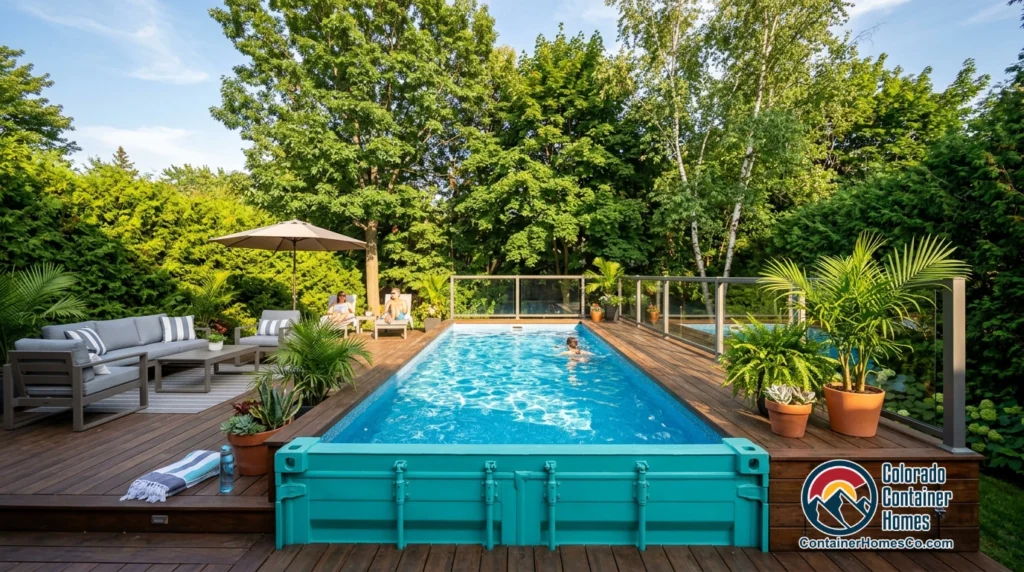
You Begin With a Structure That Already Exists
A conventional concrete pool must be created in the backyard. Contractors excavate the shape, install reinforcing steel, run plumbing and then form or spray the pool shell. A fiberglass pool arrives as a finished shell, but the yard must still be excavated to accept its entire depth.
A container pool begins with a long, rigid steel structure that can be modified in a workshop. The builder can install its liner, plumbing, filtration connections, lights, steps and even a viewing window before delivery. That controlled production process reduces the amount of skilled work performed in your backyard and limits the number of trades waiting for one another to finish.
The potential economy doesn’t come from the container’s purchase price alone. It comes from using an existing rectangular structure and repeating a proven conversion process. If you order a relatively standard 20- or 40-foot configuration, you benefit from that repetition. If you request a vanishing edge, integrated spa, twelve-foot acrylic window and exterior cladding imported from a moon of Jupiter, you have wandered away from the economical version.
Above-Ground Installation Changes the Math
The most affordable container pools are generally installed above ground or only partially recessed. They still need an engineered, level base capable of carrying an enormous load, but they may require much less excavation than a fully buried pool.
Water weighs approximately 8.34 pounds per gallon. A long container pool can therefore place tens of thousands of pounds on its supports before accounting for the steel shell, equipment and swimmers. Setting one on loose gravel, patio pavers or four casually placed concrete blocks is not thrift. It is an experiment involving gravity.
A prepared concrete slab, engineered piers or another manufacturer-approved foundation adds to the price, but it remains a comparatively focused piece of site work. It can be especially advantageous on a property where broad excavation would disturb landscaping, retaining walls or limited access routes.
This is also where the narrow shape earns its keep. A container pool can fit along a side yard, beside a deck or across a sloped lot where the excavation required for a wider conventional pool would become expensive. A 40-foot container creates a legitimate straight swimming lane in a footprint only about eight feet wide.
Factory Completion Reduces Backyard Chaos
Some manufacturers deliver the pool as a largely self-contained unit. That can mean the liner, pump, filter, skimmer, return lines and interior steps are already fitted, leaving local contractors to prepare the foundation, make utility connections and complete the surrounding deck or landscaping.
One established manufacturer reports that its container pools are installed in days rather than months, although its published overall project range of $57,000 to $145,000 demonstrates why buyers must examine the scope behind every advertised price. Shipping distance, crane service, decking and landscaping can turn the same basic pool into very different projects.
Factory construction can also reduce weather delays. A week of rain is irritating when you are waiting for a container to be placed. It is considerably more troublesome when your backyard has already become an excavated mud basin.
Spend Money on the Conversion, Not Just the Container
An unmodified shipping container is not a swimming pool. Filling one with water invites corrosion, leakage and potentially serious structural trouble. Cutting away the roof and adding windows or doors changes the behavior of the steel shell, so the modified container may require additional framing and professional engineering.
The interior also needs a purpose-built waterproof system, usually a liner or fabricated pool insert. Plumbing penetrations must be sealed correctly, and the steel exterior needs suitable corrosion protection. These are not good places to practice aggressive bargain hunting.
Before ordering, ask whether the quoted package includes structural reinforcement, interior waterproofing, insulation, filtration, electrical controls, delivery, unloading and startup. Obtain warranty terms for both the pool shell and its waterproof lining. A low factory price that excludes half the functioning pool is merely an invoice arriving in installments.
Permits and Safety Still Apply
Calling the structure “portable” does not automatically exempt it from local pool regulations. Building, electrical and zoning approvals may be required, along with setbacks, drainage provisions and a compliant safety barrier. The International Swimming Pool and Spa Code covers residential pool design, barriers, circulation systems and other safety requirements, although your locally adopted rules control the actual project.
Discuss the pool with your building department and home insurer before paying a deposit. Also determine whether an elevated container wall can serve as part of the required barrier; the answer depends on the installation and local code, not the salesperson’s optimism.
A container pool is economical when you preserve what makes it simple: a standard rectangular shell, modest site preparation, straightforward access and limited customization. Place it above ground, build a good deck around one side and resist the urge to redesign it into a miniature aquatic resort. Done that way, you aren’t buying a cheap pool. You are avoiding several of the expensive operations that make conventional pool construction cost so much.